
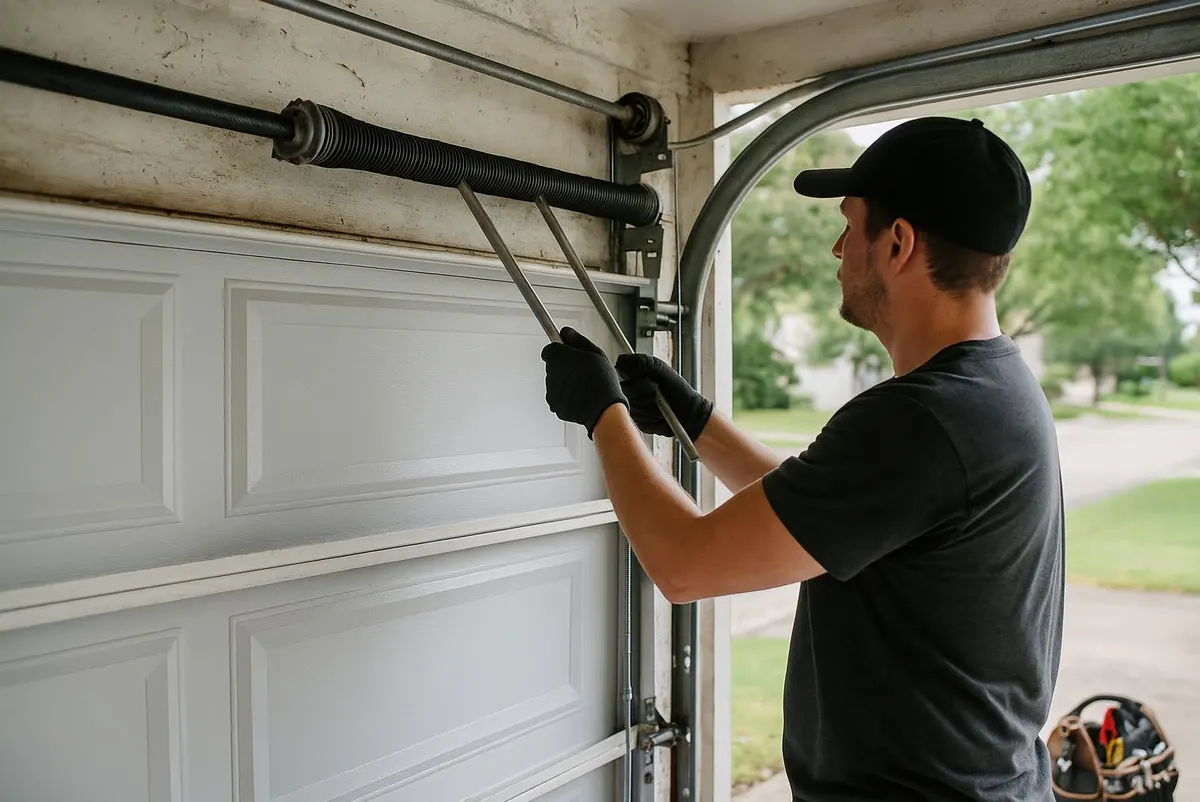
What a Technician Sees on This Call
It usually starts with a service call for something else entirely—a noisy opener, a spring replacement—and the homeowner brings up the garage door insulation argument they've been having with their spouse. One of them wants to upgrade to a fully insulated door because "it'll help the AC bill." The other thinks it's a waste of money for a garage that isn't even air conditioned. Both of them are half right, and the answer depends on how the garage is actually used, not on what the door's R-value sticker says.
Most of the insulated doors we inspect in attached garages here were installed because a salesperson pushed the highest R-value option, not because anyone did the math on whether it mattered for that specific house.
What R-Value Actually Means
R-value measures how well a material resists heat transfer. Higher R-value means slower heat movement through the door panel. That's it. It doesn't mean the garage stays cool, it doesn't mean your energy bill drops by a fixed percentage, and it doesn't account for the biggest source of heat and air loss in most garages: the gaps around the door, not the door panel itself.
A garage door is made of two steel skins with foam injected between them. The foam is either polystyrene (rigid panels, lower R-value, usually R-6 to R-9) or polyurethane (sprayed in, bonds to both steel skins, usually R-12 to R-18 or higher). Polyurethane also makes the door stiffer and quieter, which matters more than people expect once wind gets involved during storm season.
Who Actually Benefits
Insulation earns its keep in a few specific situations:
- Attached garages with a shared wall to living space. If a bedroom, laundry room, or home office sits next to or above the garage, an insulated door reduces how much heat radiates through that shared wall, especially during a Florida afternoon when the garage can turn into an oven.
- Garages used as workshops, gyms, or hobby spaces. If someone spends real time out there, insulation makes the temperature swing less brutal, even without AC.
- Homes with a garage-mounted opener and sensitive electronics. Extreme heat shortens the life of opener circuit boards and battery backups. An insulated door keeps the air inside a few degrees cooler on average.
- Anyone dealing with door panel warping. The dual-layer steel construction on insulated doors resists the swelling and flexing that humidity causes in thinner single-layer doors. That's a real durability win in this climate, separate from the R-value number entirely.
Who's Paying for Nothing
If the garage is a detached structure used only for storage, lawn equipment, and the occasional project, a high R-value door isn't doing much. Heat still comes through the walls, the roof, and every time the door opens. Paying extra for R-18 foam in a building with no insulation anywhere else is spending money on the one component that was never the weak link.
Same goes for homeowners expecting a specific dollar amount shaved off their electric bill. An insulated door helps the garage hold temperature better, which can reduce how hard an adjacent room's AC has to work, but it's one piece of a bigger envelope. If the attic above the garage is poorly ventilated or the weatherstripping around the door is shot, that's where the money should go first, not into a higher R-value panel.
The Local Factor That Actually Matters More
In this part of Florida, the bigger payoff from an insulated door often isn't thermal at all—it's structural. The steel sandwich construction is stiffer, which helps with wind load performance during hurricane season, and it resists the rust and swelling that single-layer steel or wood doors pick up from humidity and salt air closer to the coast. If you're replacing a door anyway, those two factors are worth weighing alongside R-value, not instead of it.
When to Call Winter Haven Garage Door
If you're trying to figure out whether insulation makes sense for your specific garage, bring us the actual situation: what's next to the garage, how it's used, what the current door looks like after a few humid seasons. During a garage door installation consultation, we'll walk through whether a polyurethane core is worth the upgrade for your layout or whether that money is better spent on weatherstripping, a new bottom seal, or opener upgrades. If your existing door is already warped, rusting at the seams, or rattling loose from storm-season wind, that's a sign to schedule a repair visit before insulation even enters the conversation.
Settle the argument with facts instead of guesswork—call Winter Haven Garage Door and we'll tell you straight whether an insulated door is worth it for your home in Winter Haven, FL.